Friday, August 03, 2012

The Hearst Castle

I was curious about the Hearst Castle, though I did not know much about it, except that it was a huge house, built early in the 20th century, by William Randolph Hearst, somewhere along the California coast. It sounded interesting, but I also must admit I expected it to be some tasteless, glittery example of rich guy excess. Well, there is a touch (!) of excess involved, but I now must concede that it is beautiful and well worth the price of admission. If you are interested in the history and the celebrity parties and all that, it is all here. One of the aspects of the story that most fascinated me was the architect—Julia Morgan, who worked with Hearst on the design and building of the castle from 1919 to 1947. It was so unusual for a woman to be an architect at that time and she was brilliant.

The castle sits high on a hilltop, part of the Hearst family ranch that remains a working cattle ranch to this day. We purchased our tickets at the fancy visitor's center and boarded a bus to make the winding trip up to the castle for our tour.


As we disembarked from the bus and climbed the stairs to the large plaza area in the front of the house, the first thing that caught my attention was this rabbit tile, set into the bricks, just the beginning of many small, beautiful details found everywhere on the property.

The building was inspired by different European cathedrals with a grand central entrance and double towers.
Set designers for the Harry Potter movies studied the dining room as inspiration for the dining hall at Hogwarts.

The swimming pool.

The back side.

I chose just a few of my favorite photos. I took a lot more. Stunning views wherever you look.  I recommend a visit if you are in the area. The closest town is the very small town of San Simeon.

Wednesday, August 01, 2012

Salinas and Monterey

After visiting the San Juan Batista Mission, we headed to Salinas, where we spent a couple nights with plans to explore the surrounding areas.

How's this for a California image? Agriculture and movie stars! This large painting greeted us in the lobby of the John Steinbeck Center in Salinas. Steinbeck grew up in Salinas and many of his novels were set in the surrounding area and drew liberally from his life and the history and culture of this rich agricultural area.


A couple years ago I read East of Eden by Steinbeck, possibly for the first time. I know I saw the movie years ago, so I'm not sure I had ever read the book. It was a bit of a soap opera, but Steinbeck's writing is so strong and descriptive that all his books are, for me, a treat to read. So many were made into plays and movies. His work is really definitive about a certain era and area of American history. The museum was well-done, with lots of photos of locations and the history of the area, as well as quotes and clips from the movies to illustrate each of several of his books.


One of Steinbeck's most famous books was Cannery Row, set within the culture of the fishing and processing of fish in Monterey Bay, near Salinas. So our next stop was Monterey and Cannery Row as it appears today.
Though many of the old buildings remain and have been largely repurposed, I doubt that Steinbeck would recognize Cannery Row today. It is a tourist mecca, filled with souvenir shops and restaurants. It was bustling the day we were there.

At the end of the street, housed in what was once a large fish cannery, is the Monterey Bay Aquarium, where we spent the afternoon. Here is the place in this narrative that I could easily bog down with all the photos I took in the aquarium. It was mesmerizing. Beautiful. Amazing. Thrilling. It was like stepping into a dream inside that aquarium. I may post more of my photos later, but I will leave you with one from my favorite exhibit—seahorses. Who knew they were so varied and so graceful and hypnotic to watch? Not I.


Note: After yesterday's post Christine asked if the mission bell markers along El Camino Real are also light fixtures. The answer is no. But the history of these bell markers is interesting. They were put up more than 100 years ago and because they had fallen into disrepair and many had vanished, a restoration effort was begun several years ago. They are a very charming feature of the historic road through California. More information about them here.

Tuesday, July 31, 2012

El Camino Real

We headed south into California a little more than a week ago. Just south of Oregon, where we live, California dominates the West coast, both as a huge and diverse physical presence as well as an economy and culture unto itself—almost a separate country that we both admire and revile from our adjacent position on the map. There is something so aloof and superior about California that the rest of the west cannot help but feel intimidated by its outrageousness, but eventually we all succumb to some reason to travel there and with both awe and fear we hit the road. We were headed, eventually, to Long Beach to view the Twelve by Twelve exhibit at the International Quilt Festival. It seemed like an opportunity to confront California and get to know a little more about it than  previous trips to selected destinations had allowed.

After our first night in Corning, the olive capitol of the world, we veered west to meet up with highway 101, a part of the historic El Camino Real, the Royal Road of the Spanish settlers, marked by these distinctive mission bell markers.

California has been a part of Spain, of Mexico and of the United States. Beginning about 1769, while part of Spain, the Franciscan order began building missions along El Camino Real, about a day's travel apart, 21 in all. The first real stop on our trip was the Mission San Juan Batista.

I cannot explain it, but I am fascinated by old  colonial Catholic churches and missions. I am not Catholic, not even really religious, but the history is compelling—that missionary passion and zeal to convert is inexplicable to me, but seems so strong and has created such vivid history in north, central and south America. It was not always benevolent and often shameful in its view of the indigenous groups they were hoping to "save" but there is a consistency of vision and culture planted so confidently in these unlikely places that fascinates me. It is all the same, whether in Ecuador, or Puerto Rico or Mexico or California, and I find it visually stunning. I feel I have taken this same photo of a long arched walkway across the front of an ancient adobe church at least a hundred times. It draws me in.

Gardens, chapels, candles, statues. I almost feel as if I have known these places in another lifetime. Haunting. Beautiful.
The shape of that window alcove knocks me out. Inspired.


And the obligatory statue of Father Junipero Serra, the founder of the California Missions. We ran into him a lot along El Camino Real.


Sunday, July 29, 2012

I'm Back

Yes, I have been missing in action for more than a week now. We just got back this evening from a trip to California. Our final destination was the International Quilt Festival in Long Beach, where the Twelve by Twelve quilts were being shown. But we had some great adventures on our way there, including California Missions and the Monterey Bay Aquarium and Hearst Castle, just to name a few. I will be back with photos and stories in the days to come, but tonight I just wanted to check in and explain my absence before I fall, gratefully, into my own cozy bed.

As in Houston, the Twelve by Twelve exhibit was a big hit and again took my breath away to see what we have done. It is stunning to see all 288 pieces all together. How was I lucky enough to be a part of this?

P.S. I just had to add this picture, stolen from Gerrie, of me, Gerrie, Karen and our sponsor, Del. I thought it really showed how happy we all were that day. Giddy, almost.

Thursday, July 19, 2012

Nice news

I have been working pretty steadily to finish four  "elements" themed pieces to submit for our next High Fiber Diet show. I got word today that all four were accepted. That was really nice to hear and I also learned today that I have a buyer for one of them, which is extra nice. Here are the four pieces, finished.

I finally finished Marco's quilt and something special to go with it. I will post those later so as not to spoil the surprise for him. I know he reads my blog. (He is bright for two years old—yeah.)

This afternoon I was at my computer and something out the back window caught my eye. Can you see it?


Yup, a deer. In the backyard. He seemed to be checking out the kids' toys and the sandbox. Awfully pretty deer, but pretty brazen to be so near to the house like that.

I shooed him away and he trotted down the driveway, but stopped to look back at me before scampering off into the brush. I haven't checked to see how many roses he ate.

Sunday, July 15, 2012

The Color of Summer

Is orange, I'm pretty sure. At least at our house. This year. We are surrounded by it and it makes me happy, happy.

Crocosmia and lilies and shasta daisies.

More lilies.

Lantana.

Nasturtiums and agapanthus.

More nasturtiums. (you can't have too many.)

Wildflower mix with lots of California poppies.

Can't remember what these are called.

And out in the studio more orange. I am trying to finish up Marco's quilt for his birthday next month. It matches the garden.


My week in art

Thursday was the reveal day for the Twelve by Twelve group's "Mythology" theme 12 x 20 quilts. You can go over to our blog and see the results here. Just scroll down through the entries from Thursday. Lots of great work and really good stories to go with it. You can see my explanation of Pachamama, the Earth Mother here. Here she is.

She represents all the Earth Mother/Goddess figures from worldwide mythology, but especially the figure of Pachamama, the Quechua earth mother from the Andes of South America. What may not be noticeable, but was a fun feature that I added, are some small symbols quilted into the sky background. They include "earthly" figures of animals, insects, tree, leaf, flower, as well as the sun and a human form jumping over the moon.


Also on Thursday, was our monthly meeting of STASH at Gerrie's house. Suzy and Beth were traveling, so there were only four of us, but Gerrie had prepared a very fun project for us. She had a large, gessoed canvas set up on the patio outside her studio and a selection of acrylic paints and brushes. We did a big group painting, each of us moving around the table adding elements, adding to other peoples elements, ending up with a densely painted piece. She will cut it into 6 pieces and each of us will take one which we will incorporate into a project of our choosing.


Thursday, July 12, 2012

Mountain person

Living here in Oregon I know a lot of ocean people.  Me, I'm a mountain person. This means, simply the landscape you long for. The place where the air smells like air should smell, where you feel most alive and most at home in a very basic way. I think there are probably desert people and prairie people and city people too. That is why it felt so wonderful to drive through forests and up winding mountain roads on our recent trip. I'm a mountain person.

The Beartooth Highway, (my Dad always called it "The Cooke City Highway") goes from Cooke City, Montana to Red Lodge, Montana. Charles Kuralt called it the most beautiful drive in America. Last week, after spreading my Aunt and Uncle's ashes near the highway, just out of Cooke City, we drove to the summit.

You climb upward beyond the timberline where there are vast alpine meadows and small lakes. Still big patches of snow early in July, but lots of wildflowers as well. The road winds in a serpentine pattern up the mountain.

Partway up you cross over into Wyoming for awhile, then at the summit you are back in Montana.

Coming back down you see a stunning view of Index and Pilot Mountains.

We stayed in Cooke City, a small town just northeast of the north entrance to Yellowstone Park.It was beautiful and not overrun by tourists. Just a main street, with some pretty old buildings, but the surrounding mountains made it seem like a movie set.

A forest fire came close to the town some years back.

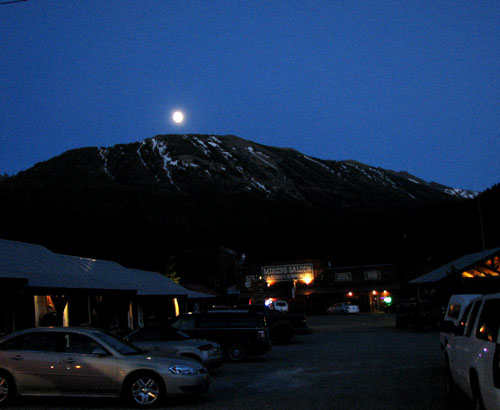
One evening Ray, my brother Steve, and I walked across the street from our motel to the saloon, just as the moon was coming up over the mountain. Not much action in the saloon, but we sat and had a drink and listened to a young guy play guitar and sing. We were his only audience it seemed. We told him we enjoyed the music and tossed a few dollars into his tip jar. The next night we had a big, catered family dinner at the old lodge where the rest of our group was staying. The caterer, cook, server, cleaner-upper was one guy—the same guy who was providing the music at the saloon the night before. Small town.

I can look at that photo of the moon and smell the pine-scented air and feel the cool mountain breeze after a brilliant, hot day. Intoxicating stuff for a mountain person.